

Marble and natural stones grace the interiors, defining the essence of high-end living
Embracing marble within the confines of apartments or villas signals not just premium quality but elevates the property's status, casting a glow on its market allure. Marble, a paragon of natural beauty, bestows a unique tapestry of patterns and hues upon each stone slab, bestowing spaces with an air of individuality and originality. The interior design metamorphoses into an opulent, unparalleled masterpiece, a testament to sophistication and luxury.

Why do marble and natural stones command a high price in interior design?
The budget for incorporating marble into interior solutions is elevated due to a combination of factors:
- Material Costs: Taking into account the uniqueness of the stone, the labor-intensive extraction process, logistics, and the intricate treatment, the cost of the material itself plays a significant role.
- Work Costs and Associated Expenses: This encompasses expenses related to transportation, processing, laying, and handling the material on-site. The overall expenditure involves skilled craftsmanship and intricate procedures.
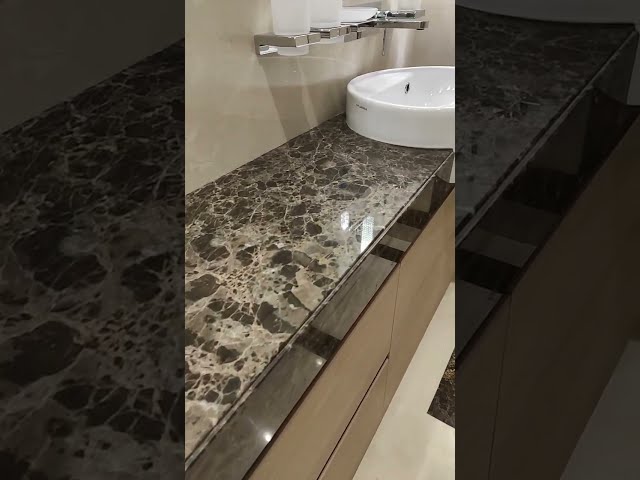
What influences the price of materials such as marble, onyx, granite, and other natural stones?
Uniqueness of the Material
Marble and natural stones stand as unique and unchanging natural marvels. Their distinct patterns, colors, and textures render each slab or stone an unparalleled work of nature. This exclusivity often translates into a higher material price.
Labor-Intensive Extraction
The extraction process of marble and natural stones demands substantial resources. It involves intricate technologies and skilled labor, influencing their overall cost.
Logistics
Transporting stone from quarry to usage site adds to the overall expense. Materials may come from different regions, and transportation costs depend on the distance between the quarry and the construction site.
Material Processing.
Marble and other stones require specialized processing to achieve high quality and accentuate their natural beauty. This process may involve polishing, cutting, shaping, and other labor-intensive operations.

Cost Components of Marble Work:
Selection of Marble Slabs.
To achieve truly exceptional results, architects (or interior designers) and clients should ideally visit a warehouse or quarry together to choose and sign specific marble slabs that match in terms of quality, shade, and pattern.
- Personally inspecting the slabs allows the architect and client to more intricately assess the color, texture, and patterns of the marble, enabling a more informed selection based on personal preferences.
- Each marble slab is unique, and their appearance can vary even within the same type. Being present at the factory provides the opportunity to select specific slabs that best meet the client's expectations.
- Visiting the factory allows checking the color consistency between different slabs and ensuring they blend as planned.
- Personal presence during marble selection helps avoid disappointment associated with potential discrepancies between expectations and reality, reducing the risk of misunderstandings in the selection process.
- The architect's presence can provide professional consultations regarding the technical aspects of marble, such as its strength, suitable processing methods, and installation.

Layout Design and Material Quantity Calculation.
Developing the layout design in accordance with the chosen pattern, addressing issues of cuts and joints, and determining the necessary amount of marble considering room dimensions, layout plan, and potential waste during cutting. While standard marble tiles of uniform size can be cost-effective, using them may negatively impact the aesthetics, uniqueness of the interior, and the property's status.

Cutting and processing marble.
Forming details and partially processing marble based on the required dimensions and shapes is initially done at the factory, followed by final cutting, adjustments, and fitting on-site. On-site marble cutting may be less precise and of lower quality, requiring specialized equipment and an experienced operator. It generates a considerable amount of dust and waste, necessitating additional safety measures, and may consume extra time and resources. Limitations may arise due to limited space, and material losses due to cutting errors are possible. Additional processing may be needed after cutting to enhance the material's appearance and quality.
Critical Task - Marble Delivery: Transportation to the Site, Elevating to Floors.
A crucial task is transporting several tons of marble from the quarry to the construction or renovation site, reloading, and lifting heavy, large-format pieces while adhering to safety measures, avoiding slab fractures, and preserving edges and facets. Large-sized machinery often cannot approach the site directly, posing additional challenges for marble delivery. In such cases, the following measures are necessary:
Use of Compact Transport Vehicles:
Employing smaller transport vehicles to move marble from the delivery point to the site. This might involve specialized trucks or trailers of more compact dimensions.Transport Vehicles with Lifting Equipment:
If access to the site is restricted, considering the use of transport vehicles with lifting equipment, such as cranes, to lift the material from the delivery point to the required height.
Transfer Using Loaders:
In the absence of transport with lifting equipment, considering the use of manipulators or other devices to transfer marble slabs from one vehicle to another until reaching the site.Material Division:
In some cases, opting to divide the marble into smaller pieces to facilitate transportation and lifting. However, this may require additional on-site processing and result in additional seams.

Surface Preparation
Base Cleaning and Leveling:
Cleaning and leveling the base onto which marble will be laid, ensuring a strong and uniform fit of the stone. The floor screed for marble should be even, horizontal, capable of bearing the weight of the slabs, with good adhesion and no cracks. The surface should be dry and comply with the manufacturer's recommendations.Different Flooring Levels:
If different floor coverings are used in apartment or villa interiors, establishing different screed levels considering the varying thickness of materials to achieve a level floor.Floor Priming:
Priming the floor before marble installation is a crucial step in preparation. It ensures good adhesion, improves surface strength, and prevents moisture absorption.
Marble Installation
Laying marble involves using specialized tools and adhesives, considering the pattern and shades of the slabs, with results monitored using a laser level.
After preparing and priming the surface for quality adhesion, marble slabs and pieces are meticulously laid using a specially applied adhesive, considering the chosen pattern or design. After installation, the slabs are leveled, and the joints between them are filled to create a smooth and even surface.
Cleaning the surface of any excess glue and other contaminants is the next important step. After installation, it is essential to allow sufficient time for the marble to dry and set before proceeding to the next steps. This drying period contributes to strengthening the connection and ensuring the stability of the laid slabs.
It is crucial to follow the manufacturer's recommendations for marble installation and use suitable materials to guarantee the durability and high-quality appearance of the laid marble.

Grouting of Joints
After laying the marble, it is crucial to perform grouting and joint filling to create a seamless surface. Visually, professionally treated joints should blend seamlessly with the stone, giving the appearance of a unified marble slab.
Grouting and joint filling are carried out before polishing, at least for a day (allowing time for the fresh joints to dry). The gaps between the details are grouted and filled with special mastics, grouts, adhesives, or putties (often on a two-component basis), carefully selected and tinted to match the color of the stone, followed by the removal of excess material. After the mastics have fully dried, the marble surface is thoroughly cleaned of any residue. If necessary, additional polishing of the joints can be done to achieve a smoother appearance. This process not only ensures an aesthetic look but also strengthens the connections between marble slabs.
Marble Grinding and Polishing
Using rotary or rotary-orbital grinding machines, hand tools, and sets of abrasive pads with varying grits, the removal of irregularities and grinding of the surface is carried out to achieve smoothness. Subsequently, polishing is performed to impart a shine and gloss to the marble surface.
Marble Crystallization
This involves a thermochemical reaction of a special composition (crystallizer) with marble, aimed at strengthening the structure of its upper surface layer, enhancing its shine, and increasing scratch resistance.


All these factors, collectively, impact the budget, making marble in interior design an elite material within a high-priced segment. It serves as an indicator of high status and luxury, significantly elevating the market value of the property.
READY TO ORDER MARBLE AND NATURAL STONE? OUR SERVICES
Our designers and architects are ready to turn your dreams into reality, creating perfect 3D visualizations and providing services for the design and detailing of marble and natural stone. We collaborate with leading quarries and professional material suppliers adhering to the highest quality standards, ensuring top-notch work in cladding and installation.
We believe that natural stones are not just building materials but true works of art, a natural gift that adds refinement and uniqueness to every project. With 20 YEARS OF EXPERIENCE, our company specializes in the turnkey creation of restaurants, hotels, SPA centers, banquet halls (conference rooms), and apartments. Our expertise encompasses design development, engineering network and communication installation, construction and finishing works, furniture and decor production, as well as finishing material and accessory procurement.

Our architect-designers work as a UNIFIED TEAM with professional hotel managers, construction engineers, electrical, heating, water supply, ventilation, and air conditioning experts, as well as furniture manufacturing specialists - ALL WITHIN ONE COMPANY. This allows for obtaining all necessary consultations during the project development phase, ensuring project alignment with implementers, and accurately calculating the cost of its realization.
A whole team of specialized professionals with extensive experience will work on your project, knowing how to create a project from scratch and effectively bring it to life – professional hotel managers, architects, designers, engineers, builders, and procurement managers.
We don't just design, build, and furnish apartments – WE CREATE SOMETHING TO BE PROUD OF!
Are you looking for the best crew to make design and renovation of apartment or villa on the French Riviera? Civilly's experts will do their best!
Call us or contact us right now!